AFL
16 minutes ago
Tribunal: Lachie Neale learns fate after four hour trial
By SEN

Download the SEN App
Your Home of Sport, In your Hand
Lachie Neale today faced the Tribunal, arguing against his one-match ban handed down over an intentional gut punch on Hawthorn’s Jack Ginnivan.
After four and a half hours, and over an hour and a half of deliberation, the Tribunal has UPHELD Lachie Neale’s suspension.
As it stands, he will miss the 2026 AFL Grand Final.
See the Tribunal’s deliberation as it happened below.
Neale’s team entered with three major arguments - The hit was not a strike, if it were a strike, it should be graded as low impact, and if all else fails, he should get off on exceptional and compelling circumstances.
As you could probably judge by the outcome, none of those arguments stood in the eyes of the AFL Tribunal.
As it stands, Lachie Neale will miss the 2026 AFL Grand Final.
But, it’s not completely over for Neale and the Loons, who will certainly take up the decision with the AFL Appeals Board.
See the Tribunal’s reasoning below:
We have no difficulty in finding that this was an intentional strike and that the impact was medium.
The vision shows that Neale jogged towards Ginnivan from a distance of several meters on an angle to the left of and behind Ginnivan.
Neale’s evidence is that he did so because he saw Ginnivan on top of Eric Hipwood and it seemed to Neale that Ginnivan had given Hipwood a couple of jumper punches.
Neale’s sole motivation for approaching Ginnivan was to respond physically to Ginnivan for this.
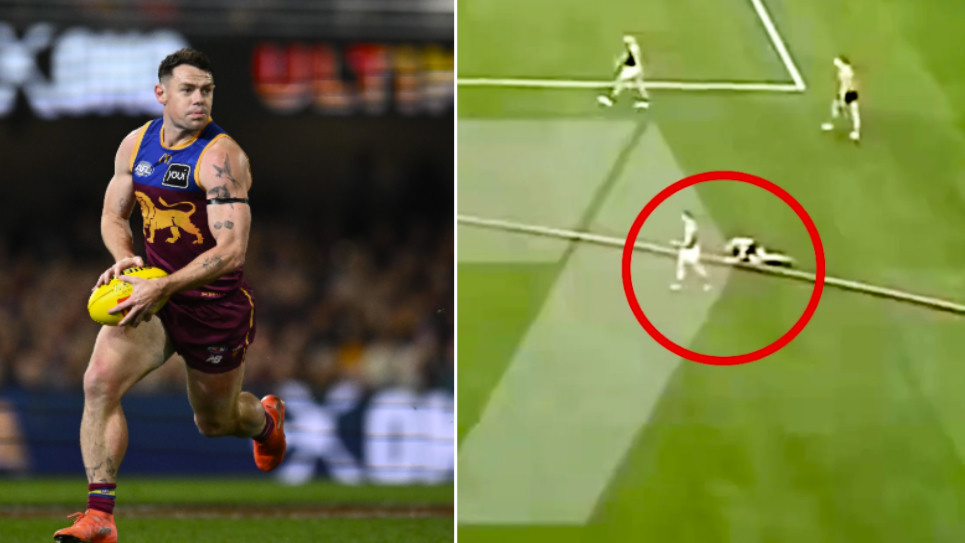
The vision then clearly shows Neale draw his left arm back to some extent and swing it forcefully at Ginnivan's body.
It is the case that there is no single frame of the vision that clearly shows Neale’s hand or lower arm making contact with Ginnivan’s abdomen, but what the vision does clearly show is all entirely consistent with that contact having been made.
Ginnivan immediately doubles over in a manner that is not consistent with him having been chested or body checked, and is only consistent with him having received more than negligible impact to the abdomen.
He goes to ground in a manner that is consistent with having been struck in the abdomen.
We do not accept that he went to ground due to being pushed or assisted by Neale’s right hand.
We do not find that Ginnivan’s response is exaggerated. It is immediate and spontaneous.
He doesn't stay on the ground for any prolonged period of time. He is not acting in a way consistent with trying to attract the attention of the umpire. He would not logically get back to his feet in the way he did, if his initial crumpling and going to ground was effected or exaggerated for the purpose of milking a free kick.
We place little weight on the hearsay evidence from Neale about Ginnivan having said to him in a phone call today that he felt it was more like a bump or a body check.
No application was made to call evidence to this effect from Ginnivan and there was no opportunity for the hearsay evidence from Neale to be tested in cross examination of Ginnivan.
Neale’s evidence was that he did not clench his fist, and there is no video evidence of sufficient clarity to the contrary.
But of course, a strike can occur with an open hand or arm. Having carefully reviewed the evidence and listened to Neale’s explanation, we find that this was a forceful blow, delivered with a swinging arm and an open hand.
When played at normal speed, it appears clear to us that this was, to use the common vernacular, a strike to the guts.
We are comfortably satisfied that this is what occurred.
We find that this is what Neale intended.
He had time to consider his action as he jogged towards Ginnivan. He moved his arm back so as to effect a strike, and he did effect the strike.
It is not a case where he intended one non-striking action, and due to carelessness, that intended action turned out to be a strike.
Neale jogged towards Ginnivan and formed the immediate intention to swing his arm and hand forcefully at Ginnivan, and that is what he did.
It follows from what we have said that we have listened carefully to Neale’s evidence, but we find that it was inconsistent in key respects with what we saw on the video, and to that extent, we do not accept it.
There is no doubt in our mind that this should be graded as medium impact.
While Ginnivan was not injured and did not appear to suffer any significant pain or discomfort, the blow was forceful and knocked him off his feet.
As we have said, he immediately doubled over in a manner consistent with a more than negligible blow having landed.
It was submitted that Neale’s arm wrapped around Ginnivan's body and arm. We reject this evidence.
The vision shows that while Neale’s arm may have made contact with Ginnivan’s left arm or shoulder, this did little to reduce its impact.
Neale also gave evidence that it felt like Ginnivan’s arm was wrapping his arm up like in a tackle. This is not consistent with the video evidence, and we reject it.
The Tribunal guidelines provide that an intentional strike, where non-negligible contact occurs to the victim player's body, will usually be classified as medium impact at a minimum.
As noted, we find that this was not negligible impact.
There was a deal of debate about whether Ginnivan saw Neale before the blow landed. We find that he probably did see Neale momentarily before the blow landed, and that he moved his arm and left leg in a reflexive manner that was consistent with him expecting contact.
What is less clear is whether those movements are consistent with expecting it to be struck in the abdomen.
In any event, we do not find that Ginnivan had sufficient time to move in a way that blocked or appreciably deflected Neale’s strike.
We note that the guidelines provide that in the case of any intentional strike, strong consideration will be given to the distance the incident occurs from the ball and the expectation of the victim player.
It is relevant that this strike occurred nowhere near the ball, was not affected in or around the play, and because Ginnivan did not see Neale coming from behind and to the side until the very last moment, he had no expectation of being struck until it was too late to meaningfully defend himself.
We were referred to a number of other examples from 2026 of strikes to the body.
In some of those examples where the grading of impact was medium, the victim player went to ground, and in others, the victim player did not.
We are comfortable that this grading of medium impact is consistent with the grading of other strikes to the body to which we have been taken.
We are satisfied that this impact should be graded in line with what the guidelines indicate would be the usual grading.
We are mindful of the significant consequences for Neale of this finding of intentional strike, but we find the evidence to be cogent and have no doubt that this was an intentional strike with medium impact.
This brings us to the more difficult issue of whether there are exceptional and compelling circumstances that would make it inappropriate or unreasonable to apply a one-match suspension.
There are matters trending both ways on this issue.
The important matters that favour this outcome include the following:
A. Neale has played 320 games without being suspended, despite having been involved in thousands of contests and frequently having been tagged,
B. He has won two Brownlow medals for having been the best and fairest in the competition.
C. He has won a host of other awards, including club best and fairest awards.
D. This combination of games played, Brownlow, and other awards won, and absence of suspension puts him in extremely rare air. Of the 13,366 players to have ever played VFL or AFL, only 65 have played 320 or more games. That is less than half a percent, and only 25 of them have done so without a suspension.
E. It was forcefully put on behalf of Neale that such an extraordinary record means that he should not be suspended.
F. Ginnivan was not injured.
Having given the matter very careful consideration, however, we find that these matters do not either individually or collectively render it inappropriate or unreasonable to apply a one-match suspension for this intentional strike.
In forming this conclusion, we take into account the following factors:
A. This was an intentional strike
B. We understand that there is no previous instance of an intentional offence having been having attracted the benefit of this provision. That is not to say it could never be available for an intentional offence, but it is important to note that in the two matters on which considerable attention was focused, namely Pendlebury and Cameron, the Tribunal found that not only was the conduct careless, but that it was not at the upper end of the range of careless. Those two matters involve acts that were in the play.
C. The intention was not formed in a split second. Neale jogged towards Ginnivan and had time to consider whether and how he would physically remonstrate with Ginnivan.
D. Neale came partly from behind Ginnivan until very shortly before he delivered the blow. It was not a strike that was the culmination of grappling or scuffling, where the victim player may have anticipated some form of heavy physical contact.
E. While Neale has never been suspended in his long career, this is the fourth occasion on which he has been found guilty of a strike to the body. Neale gave evidence, which we accept, that these other striking matters involved him retaliating. But the fact remains that this is not the first occasion on which Neale has been found to have struck his opponent.
F. The guideline cracking down on intentional strikes, saying that they will usually be graded as medium impact, resulting in a one-match suspension, is very clear, and Neale admitted he was aware of it.
G. The purpose of the guideline is to stamp out this very sort of conduct. Neale ignored it, and he knew the consequences.
In the end, Neale delivered an intentional strike off the ball to an unsuspecting opponent.
To use the language that has been used more than once this evening, Neale intended to strike him in the guts for the way he behaved towards Hipwood and he did strike him in the guts.
Even Neale’s outstanding record does not render a one-match suspension for that act inappropriate or unreasonable.
———-
And there we have it.
After four and a half hours, and over an hour and a half of deliberation, the Tribunal has UPHELD Neale’s suspension.
He will miss the 2026 AFL Grand Final.
——
They have returned. Here we go!
——-
We are fast approaching the four-and-a-half hour mark.
We are still awaiting the Tribunal.
——-
We've officially hit four hours.
The Tribunal is still deliberating.
Believe it or not, we are still here. And we are still waiting. We are beyond an hour of deliberation and beyond three and a half hours since the beginning of the trial.
Into hour three... still awaiting the Tribunal.
We're still here... and we're still awaiting the Tribunal.
The Tribunal is still deliberating. This one's going the distance.
The Tribunal is now deliberating.
For those still following along, here is the vision that the Tribunal is deliberating over.
Over two hours in.
Anderson has returned to the argument of exceptional and compelling circumstances.
He states that only two 300-game players to have won two Brownlows and not be suspended - Neale and Robert Harvey.
"He's been appropriately bestowed as the fairest and best player by the AFL twice and the fairest and best player at his clubs six times.”
The AFL isn't buying it, stating that exceptional or compelling circumstances shouldn't stand in place for intentional acts.
The stakes of the one-week suspension have now been raised by the Lions.
“This is potentially the most important match of Lachie Neale’s career. It could be a defining moment in the career if he’s to miss a historic opportunity to play in a threepeat Grand Final,” Anderson said.
“And I’m not saying he should be treated differently, quite the contrary... all I’m saying is the requirement of being comfortably satisfied when there is such a consequence on the line is something that needs to be taken into account when you look at that vision.”
Brisbane are now arguing that the incident mirrors that of Harley Reid and Jai Newcombe from earlier this year - both were graded as low impact.
Anderson: "If you say it's a strike, we say, at most, contact from the left arm is negligible or at such a level where it's either negligible or low impact."
Anderson has continued his defence, claiming that the primary impact is from Neale's shoulder and chest, showing an individual frame from the incident.
The AFL is standing firm that Neale's action was "clearly" a strike, arguing it was a "forceful swing of the arm" that was "not a football act".
Woods has referred back to the guidelines that state that any intentional strike to the body that is not negligible would be graded as medium impact.
"It's the potential here, rather than the result."
The Lions are fighting back.
Adrian Anderson of the Lions is arguing that at no point does the vision display a single frame of Neale's fist in Ginnivan's abdomen.
Neale is being cross-examined by AFL counsel Andrew Woods - continuing to reject the AFL's suggestion that his swinging arm was the first thing to make contact with Ginnivan.
“I don’t think that was my intention to strike him, I think it was to wrap him up and hit him with my body to let him know I wasn’t happy with what had happened beforehand,” Neale said.
“I don’t think I’ve ever thought about, in a game of football, the consequences of a report. I’ve just played and tried to play as fairly as possible and stick up for my teammates.”
He is now being questioned over his three prior striking charges, claiming that both were retaliation.
Andrew Woods: "This is a very clear strike.
"(The vision shows) clearly that the first contact is this extended arm going into Ginnivan's midriff or chest area."
Neale confirms that he today spoke to Jack Ginnivan - he also feels it was more of a bump or a body check and not a strike.
"He said he felt it was more of a bump, a body check, than a strike," Neale said.
Neale has confirmed that he has never been suspended at any senior level, from Glenelg in 2011 through to his 320 games at AFL level.
“I was very close to the incident between Jack and Eric Hipwood, where it seemed like Jack was on top of Eric and gave him a couple of jumper punches,” Neale said.
“I didn’t feel like that looked great so I went to show my disappointment in that action and ran past him to body check, bump him, and felt that my shoulder made contact with his body and shoulder first, and my arm wraps around Jack but didn’t feel like I was striking him at all.
“It was more of a bump or body check. I just didn’t like what had happened to Eric.”
After the incident:
“I was indicating that Jack might have taken a bit of a dive to get a free kick.
“He (Jack) had a bit of a smile on his face but he didn’t say anything.”
Neale has stated that after the bump, he made a motion with his hands towards Ginnivan suggesting that he took a dive. Ginnivan smiled, but did not respond.
Neale is presenting his evidence, and has claimed that his hit on Ginnivan was not a strike.
"I didn't feel like I was striking him at all. It was more of a bump or a body check."
He feels as though Ginnivan stopped and braced as Neale approached, aware that the bump was coming.
"I actually don't think it's a strike. If you do think it's a strike, arguing that it's low impact is a fair argument. If you can't get off on those two points, you could easily argue the exemplary record. He has three genuine chances to get off."
Tom Morris on SEN's Locked In.
Be sure to listen to Locked In LIVE with Kane Cornes and Tom Morris as they go through the ongoing case.
Brisbane has argued that Neale's hit on Jack Ginnivan is not a strike. If it is, Brisbane argues it's low impact rather than medium.
The Lions are also arguing exemplary and compelling circumstances due to Neale's good on-field record - similar to the compelling circumstances that freed Scott Pendlebury.
Lachie Neale is now facing the AFL Tribunal.
Lachie Neale's case at the AFL Tribunal kicks off in just under 15 minutes. We'll be running live updates as it happens right here.
Hawthorn champion Luke Hodge expects Lachie Neale to play in this Saturday’s Grand Final against Fremantle.
He explained the reasons why his former Lions teammate should take his place at the MCG as Brisbane chases a three-peat.
“Teams that have success in September, there are teams that put their ego to the side, whether it's a player or a team,” Hodge said on SEN’s Whateley.
“I reckon that's what the MRP should have done this week.
“I think they could have let it go. Don't just say it's a Grand Final, look back at the history this year of what has been suspended and what hasn't. You go to the ones that haven't been suspended, you go to the ones that what classifies as a fine."
Hodge says there are two precedents which should play into the hands of Neale and his defence.
“There's two that probably match up close to, that's the Jai Newcombe on Max Gawn and also the Harley Reid on Matt Johnson with the elbow at the stoppage. Both those players went down for a long period of time, a lot longer than what Jack Ginnivan did, got up and was still struggling when they got the free kick.
“Lachie Neale comes in, throws an arm, his left shoulder hits Jack Ginnivan's shoulder and then his arm swings around into the mid-riff - from what we can see.
“But Jack Ginnivan gets straight back up, Lachie turns around, has a bit of go at him at flopping. I think if they looked at that and went back and reverted to the ones that they gave just fines for low impact to Newcombe and Reid, that's what it classifies as.
“It's not something where Ginnivan stayed down, he wasn't winded, he got back up and move on from there. I think that would be the right one. I feel that's the way that the Tribunal will see it tonight.”
“Lachie’s played over 300 games and not been suspended. So I think that the Tribunal sit back and go, same as the Scott Pendlebury one - ‘We believe that this is too much question mark for him to miss a game. We'll give him a fine and move on’.”
Gerard Whateley agrees: “I think that would be the sensible outcome, I truly believe that's what will happen.
“And if it doesn't it'll require a lot of analysis given what's happened previously.
“I’m surprised how desperate some people are to have him suspended. I don't know what that's related to. Is that related to his off-field”?”
Hodge: “Yep. There’s no surer thing.”
Whateley: “There's such a nastiness and it's on the text, which I'm not surprised by much that comes on the text, but I think most of the time, historically, we've leant towards, ‘It’s a Grand Final’. Come on.”
Hodge: “Whoever's writing in as a text message, put your main player, your best player, and your player did that as a response. How would they justify that? Because you sit back and go, that's not worthy of missing a Grand Final, especially with a record and especially the fact that Ginnivan just got back up.
“There's a lot of hate out there for his last 12 months and people would sit back and love to see him miss just because of what he has done in his own personal life over the last 12 months.”
Can Ablett Jnr precedent save Neale's Grand Final hopes?
Adam Simpson and Gerard Whateley discussed the ban on Monday and both agreed on the absurdity of the AFL not returning just a fine.
Labelling the farce of a ban "a dead set like for like" with Gary Ablett Jnr in 2019, Whateley backed Neale to be let off.
"The (player's) record is not a loop hole it's a provision in the rules," he said.
"Gary Ablett, like for like, in 2019, he had 328 games unblemished and he gets a one week ban in the prelim, it took the tribunal three minutes to downgrade it to a fine.
"He was a dual Brownlow medallist, as is Neale who has game 320-games in an unblemished career; a one week ban for striking. Take all the emotion out of it, on basic precedent, what was applied for Ablett must be applied for Neale.
"It was the same thing for Pendlebury, but his record was in the 400s, but the dead set like for like is GA Jnr.
"Dubious suspension, a fine would have sufficed and this is why I have resisted the no wiggle room and no black and white on the strike. this is a mistake in its conception. This should have come back as a fine."
Echoing Whateley's sentiments, Simpson said the matter should never have reached the tribunal.
"What are they doing? It could have easily been a fine and low impact," he said. "I know rules are rules but it could be construed as a body check.
"It's a 50-50- call at best in my eyes. With the magnitude of everything...it's a Grand Final. To miss a Grand Final with that?
"Brisbane probably think there's a conspiracy happening here. This will be a distraction for everyone for a few days and hopefully he is allowed to play.
"I'll be so disappointed if he misses it for that.
"Look at the vision, 10m after the collision happens; Lachie suggests to Ginnivan he has taken a dive and they both laughed. It was silly, he shouldn't have done it, he has no one to blame but himself; but this will be a three minute job. I think this will come and go quick and he will play."